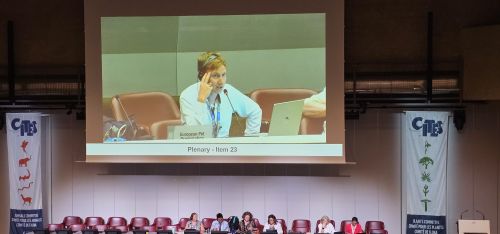
Our Chief Executive Dr Matt Bond is once again at a CITES meeting, this time it’s in Geneva at the Animals Committee, which brings together countries to discuss trading rules around animals and invertebrates. He’s there, courtesy of European Pet Organization, of which OATA is a member.
Watch this discussion between OATA CEO Dr Matt Bond and Svein Fossa, who is Vice President for Ornamental Fish International, President of the European Pet Organization and also Secretary General of the Norwegian Pet Trade Association, on why it’s important to attend CITES Animal Committee.
Here’s Matt making an intervention on the subject of stony coral. The committee has agreed to bring together a working group to look at the conversion factors used to analyse trade in stony coral. Ornamental Fish International, European Pet Organization and the Indonesian Coral, Shell, and Ornamental Fish Association (AKKII) will represent the industry on the working group. Our goal will be to push for the simplification in the reporting requirements required for those importing and exporting coral within that working group.
OATA CEO Dr Matt Bond has made another intervention on behalf of EPO, this time around how CITES listed specimens are correctly identified at the border. This agenda item is an attempt to modernise CITES guidance and use up-to-date practices, like AI, to help. We highlighted the value of engaging trade to help with this, citing the CEFAS Coral Identification Guide that OATA members provided valuable insight into to help customs officers in their work at the Border. The committee agreed to set up another working group to work on this.
Matt’s last intervention on behalf of industry was on how CITES deals with trade in specimens of animals/plants not of wild source (ie captive-bred). We welcomes the technical workshop planned to discuss this matter further and believe that CITES provisions should support, rather than discourage, sustainable captive production.